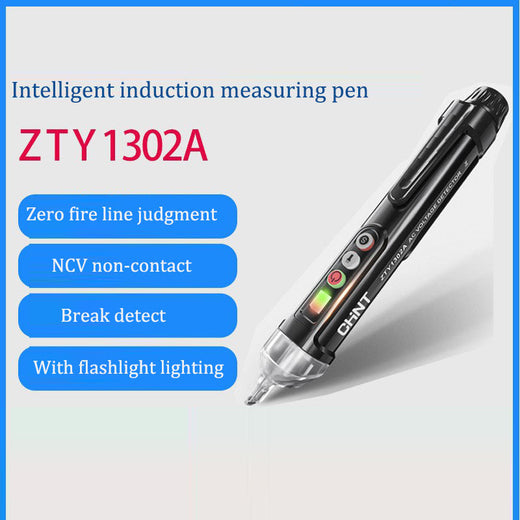
Non-Contact Voltage Testers & Detector Pens
3 products
Non-contact voltage testers and detector pens are compact test tools for checking whether an AC circuit, cable, outlet, switch, or fitting may be live without touching a conductor. This guide explains what to look for in a non-contact live wire detector and how to use it as an initial electrical check.
How to Choose a Non-Contact Voltage Tester
Start by matching the tester to the work you do most often. A detector pen is useful for quick checks around outlets, light switches, extension leads, cables, and electrical panels, while a multimeter is better when you need measured voltage, resistance, or continuity readings. Look for a clear visual or audible alert, a comfortable pen-style body, an easy-to-operate power button, and a pocket clip if you carry test tools between jobs. A built-in work light can help in dim areas. Check the product specifications for the voltage range and AC-only operation before buying. If you need to confirm that a circuit is safely de-energized, use an appropriate approved testing procedure and do not rely on a detector pen alone.
Non-Contact Voltage Detector Types Compared
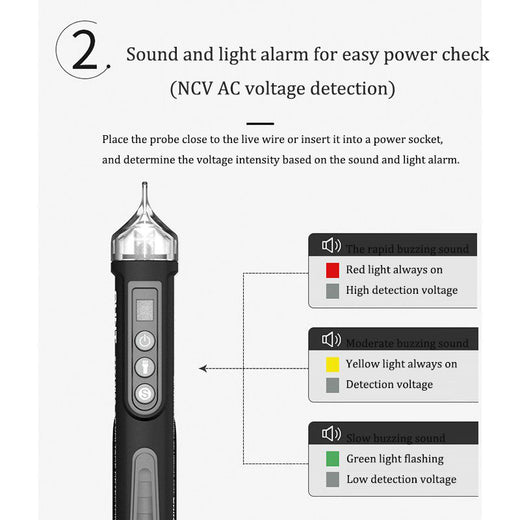
Basic detector pens provide a simple live-or-not indication when held near an AC source. Models with audible and visual alerts are easier to notice when working in a noisy room or when you cannot see the indicator clearly. Some pens include a flashlight, which is useful inside cabinets or near floor-level outlets. Adjustable sensitivity can help with different cable positions, but it may require more careful interpretation around bundled wires or nearby circuits. A non-contact tester is different from a contact voltage tester: it senses an electrical field without touching the conductor, while a contact tester uses probes or leads. These are electrical test tools, not software test tools, manual testing tools, or automation testing tools, so choose based on the physical task.
What to Look for in a Live Wire Detector
Check the stated AC detection range, alert type, power source, and operating controls. A bright LED or clearly marked indicator helps you read the result quickly; an audible alarm is useful when your eyes are focused on the cable. A low-battery warning can reduce the chance of using a weakened tester without noticing. The probe tip should be shaped for approaching outlets, terminals, and cable insulation without forcing it into an opening. A durable insulated housing and a secure battery cover are practical features for regular use. Read the instructions for the NCV Voltage Tester Pen — Non-Contact Live Wire Detector before testing, including its self-check procedure if supplied. No detector pen replaces safe isolation, suitable protective equipment, or a properly rated contact test when confirmation is required.
How to Use a Non-Contact Voltage Tester
Before testing, inspect the pen for cracks, loose parts, or damaged insulation and install the specified battery. Turn it on and verify its alert using a known live AC source that is suitable for the tester. Bring the sensing tip close to the insulated cable, outlet face, switch, or fitting without touching exposed conductors. Move slowly around the area and watch or listen for the alert. Test the known source again afterward to confirm the tester is still responding. A positive indication suggests that an AC field is present; it does not identify the exact wire, measure voltage, or prove that every conductor is dead. Follow local electrical rules and isolate power before handling wiring. If results are unexpected, stop and use a correctly rated contact tester or seek qualified assistance.
Common Mistakes When Testing for Live Wires
One common mistake is skipping the known-live check before and after testing. A flat battery, damaged pen, or incorrect operating mode can produce a misleading result. Users also test too far from the cable, move too quickly, or assume that no alert means a circuit is safe. Detection can be affected by cable position, insulation, shielding, moisture, nearby energized conductors, and the tester’s specified range. Do not use a detector pen to identify neutral, earth, or individual conductors with certainty, and do not treat it as a substitute for isolation and verification. Avoid placing the tip into an outlet or touching exposed metal unless the instructions specifically permit it. Keep this category separate from a testing tools list for software: these products detect electrical fields, not application defects or code behavior.
Who Should Use a Non-Contact Voltage Tester?
A non-contact detector pen suits homeowners, maintenance workers, electricians, installers, and technicians who need a quick preliminary check before working near AC wiring. It can help locate a potentially live cable behind an accessible surface, check an outlet or switch, or identify whether an extension lead may be energized. Its small size also makes it convenient for a toolbox or service bag. It is less suitable when you need an exact voltage reading, continuity testing, resistance measurements, or definitive proof that a circuit is isolated; choose a multimeter or approved two-pole tester for those jobs where appropriate. People searching for free software testing tools, the best testing software, or an automation testing tools list are looking for a different product category. For electrical work, select the tester by task, rating, and instructions.
Frequently asked questions
What are the test tools?
In this category, test tools are handheld electrical instruments used to check for possible AC voltage or live wiring. A non-contact voltage tester detects an electrical field near an insulated conductor without requiring direct contact. It is intended for preliminary checks and does not replace a suitable contact tester, meter, isolation procedure, or qualified electrical work.
What are the top 10 test management tools?
Test management tools usually refer to software used to plan, track, and report software tests, so they are not the same as non-contact voltage testers. This category contains physical electrical test tools rather than test management software. If you need to check a cable, outlet, switch, or fitting for a possible live AC field, a detector pen is the relevant product here.
What are the tools used in testing?
The right tool depends on what is being tested. For electrical work, common options include non-contact voltage testers, contact voltage testers, multimeters, continuity testers, and clamp meters. A detector pen provides a quick indication that AC voltage may be present, while a multimeter or other contact instrument is used when measured readings or additional functions are required.
What is the best testing software?
Testing software is used for software quality assurance and is unrelated to electrical detector pens. For electrical checks, the best tool depends on the task: a non-contact voltage tester is convenient for an initial live-wire check, while a correctly rated meter may be needed for measured voltage, continuity, or resistance. Always follow the product instructions and applicable safety procedures.
What are the four main types of software testing?
Software testing is often grouped in different ways, so there is no single universal set of four types. Common categories include functional, non-functional, manual, and automated testing, although other classifications are also used. These concepts do not apply to a non-contact voltage detector, which is a physical electrical test tool.
What are some free software testing tools?
Free software testing tools are applications for testing websites, programs, or code and are outside this electrical product category. If you need a physical tool for a possible live-wire check, the NCV Voltage Tester Pen — Non-Contact Live Wire Detector is designed for that purpose. Check its specifications and instructions before use, and do not use it as the sole proof that a circuit is safe.