
$59.90
Free delivery · 7–14 days
Hand Crank Solar Emergency Radio with Phone Charger
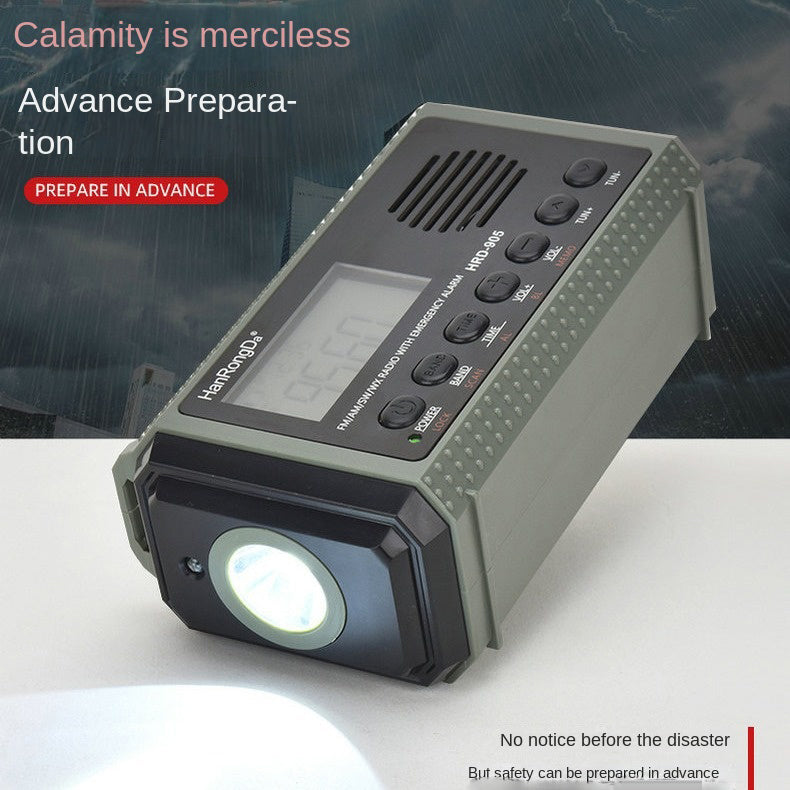


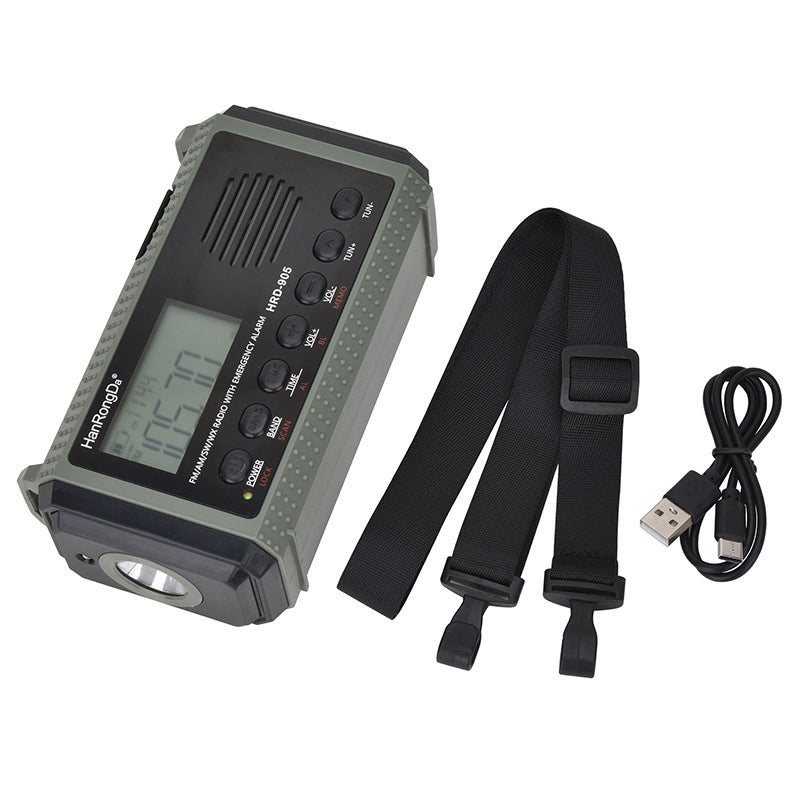
Keep the lights on, the phone charged and the weather bands in reach when the grid drops. The HRD-905 pairs a 10000mAh power bank with solar, hand-crank and DC IN charging, plus an LED flashlight, reading lamp and SOS alarm in one rugged olive-grey housing.
Read the full descriptionKeep the lights on, the phone charged and the weather bands in reach when the grid drops. The HRD-905 pairs a 10000mAh power bank with solar, hand-crank and DC IN charging, plus an LED flashlight, reading lamp and SOS alarm in one rugged olive-grey housing.
All-in-one emergency radio with 10000mAh power bank, solar and hand-crank charging, and SOS alarm for disasters
Before: a dead phone, a dark house and no way to hear the storm update. After: one rugged radio that tunes in, lights the room, charges your phone and sounds an SOS when you need help.
The telescopic whip antenna pulls in FM, AM, shortwave and the US weather band, with the frequency range printed right on the front panel. Extend it fully, set the band, and the backlit LCD shows what you are tuned to. Weather band forecasts stay available when the cell network is down.
The 10000mAh power bank sits inside the housing and feeds the USB output at 5V 1A. Plug in a phone and the radio keeps broadcasting from the same unit. Expect several phone top-ups from a full charge, which covers a long outage night without hunting for a wall socket.
The solar panel, the hand-crank generator and the DC IN 5V input each refill the battery on their own. Solar is the slowest route, so use it in open sun outdoors. Crank in longer sessions when the sky is grey, or plug into a 5V source when the wall still has power.
Connect a 5V source to the DC IN port before the outage hits. This is the fastest way to fill the 10000mAh battery when mains power is available.
Fold out the hand crank and turn it steadily. Work in longer sessions with short breaks to avoid fatigue, since a few quick turns add only a small amount of charge.
Set the panel outdoors on a sunny surface, facing the light. Solar output falls behind glass and on overcast days, so treat it as a daytime top-up rather than the main source.
Matte olive-grey rugged housing with backlit LCD
Extends for full-band reception
Mounted on the back of the unit
Folds out from the body for manual charging
For moving the unit between home, car and camp

The forecast changes in minutes and the power drops with it. The phone shows 12 percent, the flashlight is in a drawer somewhere, and the only news source is a cell feed that is already faltering. Families in this position lose the hours that matter most.

The HRD-905 pulls the broadcast bands into one housing. The LED flashlight and reading lamp light the room, the 10000mAh power bank charges a phone, and the SOS alarm sits one press away. The radio stays on while the phone charges, so nothing has to be switched off to make room for the next job.

Three recharge paths keep the unit working without a wall socket: the solar panel, the hand crank and the DC IN 5V input. Keep it charged in a fixed spot, check it once a season, and it stays in the kit, the car or the camp bag until the next alert.
Give the radio a full charge from the DC IN port or by crank, then confirm radio, flashlight and SOS all respond.
Keep the radio charged in a fixed spot and run a quick weekly check on the LCD, band tuning and flashlight.
Practice cranking and placing the solar panel in sun so you know how long each method takes for your own devices.
After a season of checks, the radio stays in your home or car kit, charged and ready for the next outage or trip.
| HRD-905 | Basic crank radio | Separate power bank | |
|---|---|---|---|
| Weather band reception | — | ||
| Built-in 10000mAh power bank | — | ||
| Solar charging | Partial | — | |
| Hand-crank charging | — | ||
| LED flashlight and reading lamp | Partial | — | |
| SOS alarm button | — | — |
10000mAh is the stored capacity of the built-in power bank, which is enough for several full phone charges from one fill. Hand cranking adds charge in proportion to effort, so short bursts add only a little. Crank steadily in longer sessions and you will see a meaningful gain.
Solar works, but it is the slowest route, and it drops sharply behind glass or under heavy cloud. The crank does not depend on weather, though it does take sustained effort. For a dependable backup, keep the unit charged before the storm and treat solar and crank as top-ups.
A basic crank radio gives you broadcast reception and nothing else. A separate power bank, flashlight and SOS beacon would cost more and take three more items to charge and carry. Buying one rugged unit that does all four jobs is the cheaper way to stay prepared, and it lasts longer in the kit because there is less to lose or run flat.
The SOS button is an alarm built into the radio itself, so it does not rely on your phone or its signal. How alerts reach responders depends on your local emergency services, so check their guidance for your area.
Yes. The unit is built for emergency kits at home or in the car, with a rugged housing, carry handles and multiple charging options. Keep it charged and reachable in the trunk, and fully extend the antenna when you tune in.
It adds a 10000mAh power bank with USB output, an LED flashlight, a reading lamp and an SOS alarm, alongside the same weather band reception. You get light and phone power in the same box, which a basic crank radio does not provide.

 Emergency Radio with 10000mAh Power Bank and Solar Charging