
$48.90
Free delivery · 7–14 days
Stainless Steel Sink Strainer That Catches Hair & Debris

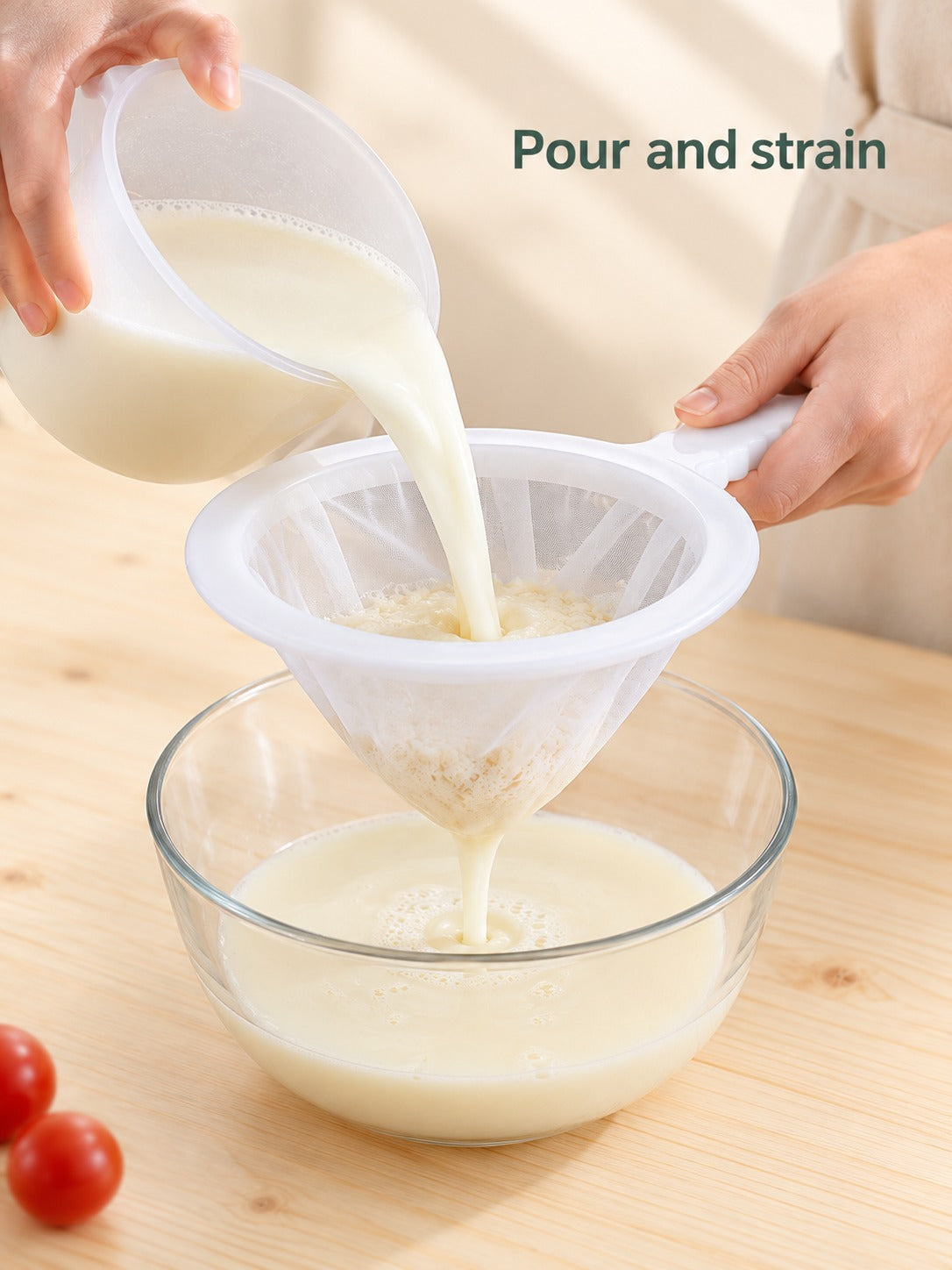


Smooth soymilk and juice without the grit, one pour at a time. The fine-mesh cloth holds back okara and pulp while the liquid drops straight into your bowl. Two cloths in the box mean one is always ready for the next batch.
Read the full descriptionSmooth soymilk and juice without the grit, one pour at a time. The fine-mesh cloth holds back okara and pulp while the liquid drops straight into your bowl. Two cloths in the box mean one is always ready for the next batch.
Ultra-fine mesh strainer that filters soymilk and juice smooth, leaving no pulp or slag behind
Gritty soymilk and pulpy juice are a daily chore. This fine-mesh strainer pours out silky liquid and holds the okara in the cloth.

The sheer cloth catches okara and slag while smooth liquid passes straight into the bowl. You can see the solids sitting in the weave after each pour, so you know exactly when the cloth needs a rinse.

The 14.5 cm flat rim sits across the bowl edge, and the ridged handle gives a firm one-handed grip. Hang the loop on a hook or let the rim rest, then pour with your other hand free.

Fresh juice and homemade stock go through the same cloth. The pulp stays behind and the glass comes out clear, so one tool covers the morning soymilk, the juice and the sauce pot.
Hook the loop over a bowl edge or a hook so the rim sits flat across the bowl.
Pour the blended soy mixture or juice in small amounts so the mesh does not flood.
Let the liquid pass through by gravity. Lift the cloth gently at the end instead of pressing it.
Rinse the cloth in cool water before the okara dries on the mesh, then switch to the second cloth for the next batch.
Flat rim sits over a bowl, with a hanging loop at the handle end
One drains while the other is in use
The ring is light, matte plastic, not heavy steel, so it feels like an everyday kitchen tool rather than a premium one. Use it over a bowl or jug, keep it clear of open flame, and let very hot liquid cool a minute before you pour. The sheer cloth is the part that wears, so replace it when the mesh thins.
It clogs far less when you rinse it straight after the batch. Okara that dries on the mesh seals the weave and is much harder to clean. Rinse the cloth in cool water as soon as the liquid drains, and pour in small amounts so the mesh does not flood.
For most batches, one pass gives a smooth glass. Very thick okara can leave some fine pulp, so if the drink still feels grainy, pour it through the same cloth a second time. Do not squeeze hard, because pushing solids through the mesh is what makes the drink gritty.
You get the strainer with its ridged handle and hanging loop, plus two fine-mesh filter cloths. With two cloths, one can drain while the other is ready, so you do not wait between batches or lose milk to a second pass through a sieve.
Rinse it in cool water right after straining, then let it dry fully before you store it. Do not leave okara sitting on the mesh overnight, since dried pulp is what makes the cloth hard to clean.
Yes. The same mesh strains fresh juice, so the pulp stays in the cloth and the glass comes out clear. It also works for stock and pan sauces, catching bits before they reach the bowl. Thicker sauces may need a second pass.


 Ultra-Fine Soymilk Filter Strainer for Smooth Juice