
$35.90
Free delivery · 7–14 days
Wooden Toddler Puzzles for Hands-On Early Learning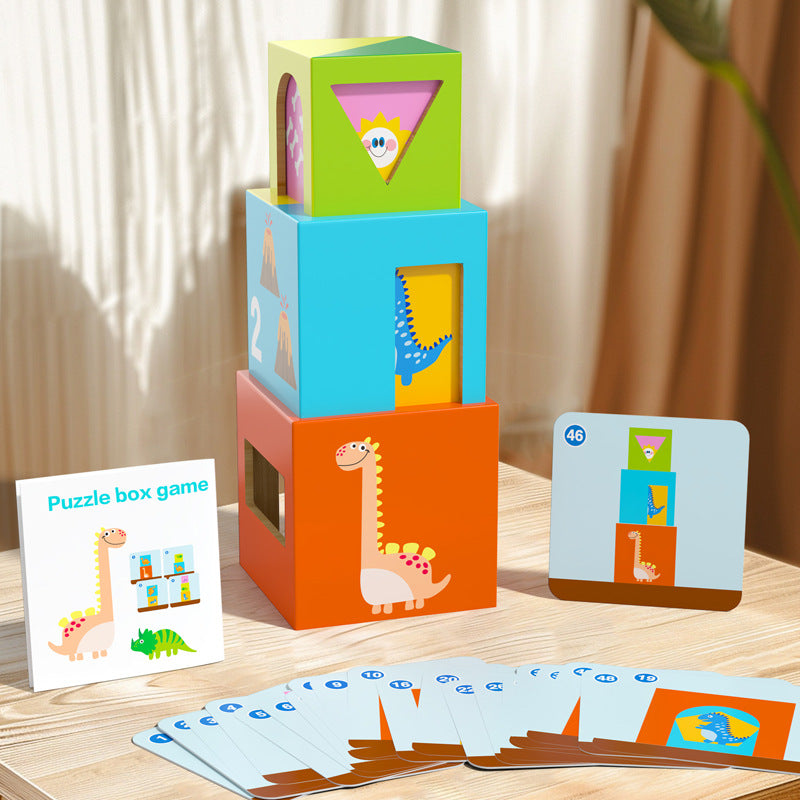



Turn quiet moments into visible little wins. This wooden puzzle box game gives preschool and early-school children colorful blocks, illustrated cards, and progressive challenges for hands-on spatial…
Read the full descriptionTurn quiet moments into visible little wins. This wooden puzzle box game gives preschool and early-school children colorful blocks, illustrated cards, and progressive challenges for hands-on spatial…
Progressive hands-on puzzle play that builds children's spatial thinking and problem-solving skills.
Instead of losing focus to another screen, children recreate colorful arrangements, practice careful hands-on thinking, and build confidence challenge by challenge.
Stackable square boxes and geometric openings let children physically test position, direction, and arrangement instead of only looking at a picture.

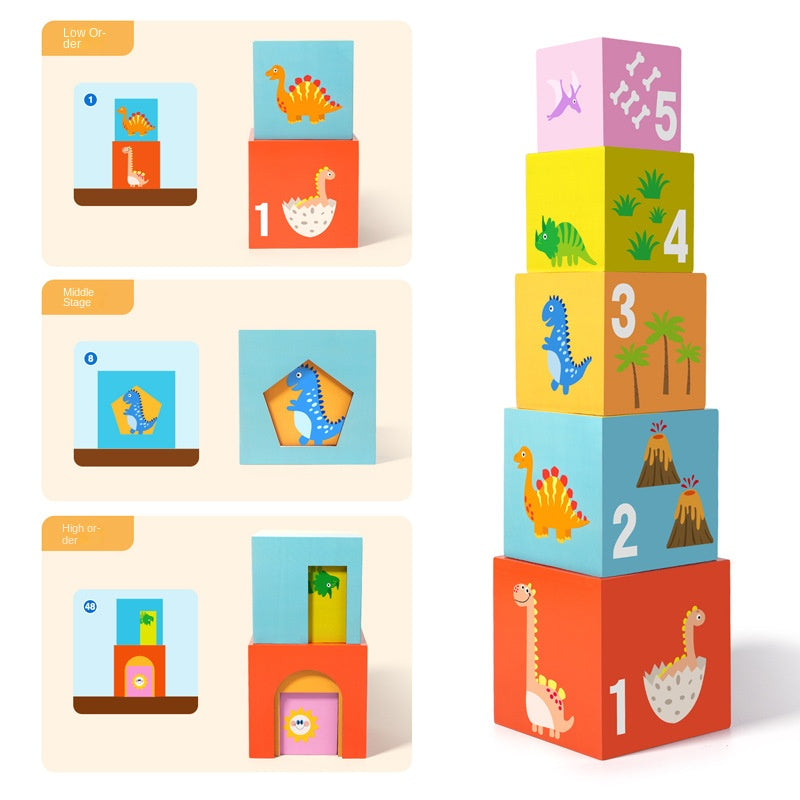
Low-order, middle-stage, and high-order challenge cards create a clear path from simple matching to more complex visual problem-solving.

Smooth painted wooden blocks give small hands a satisfying way to practice coordination, sequencing, and persistence through active play.
Illustrated numbered cards give the activity structure and variety, so the set remains useful beyond one completed puzzle.
Begin with an illustrated card that looks approachable. Start at the low-order level before moving to more demanding patterns.
Invite the child to notice the colors, animal graphics, openings, and order of the boxes before picking up a piece.
Let them rotate, place, and stack the wooden boxes until the arrangement matches the card.
When simpler cards feel comfortable, offer a middle-stage or high-order challenge and praise careful attempts over speed.
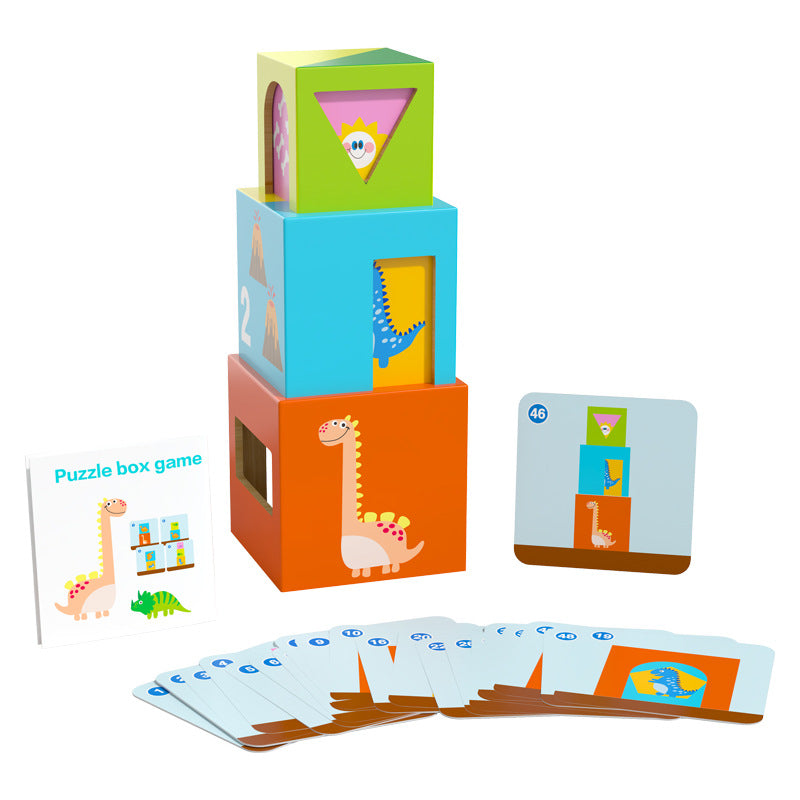
Smooth painted blocks in bright colors with geometric openings and animal graphics.
Numbered pattern cards for low-order, middle-stage, and high-order play.
Instructions for recreating the arrangements with the colored boxes.
Screens provide instant engagement, but they do not give small hands much practice with sequencing, coordination, or spatial decisions. This puzzle creates a more meaningful option for the moment when ordinary toys have lost their pull.
The challenge cards give children somewhere to begin and somewhere to go next. Low-order, middle-stage, and high-order exercises turn a difficult pattern into a series of manageable wins.
Children study the card, identify colors and openings, then rotate and stack the wooden boxes to recreate the arrangement. Observation, hand control, and problem-solving happen together in one playful routine.
The best moment is the quiet one after the final box is in place. A child can see exactly what they solved, feel that small rush of pride, and ask to try the next challenge.
| Wooden Puzzle Box Game | Screen Activity | Basic Single-Level Puzzle | |
|---|---|---|---|
| Tactile wooden construction | Yes | No | No |
| Progressive challenge levels | Yes | Partial | No |
| Physical pattern matching | Yes | No | Yes |
| Reusable across sessions | Yes | Partial | Partial |
| Supports shared parent-child play | Yes | Partial | Yes |
It suits preschool and early-school children who are ready to study pictures, handle wooden pieces, and try simple arrangements. Younger or less experienced children can begin with the easier cards and adult guidance.
They create a progression from simpler visual matching to more involved arrangements. Start with low-order cards, then move to middle-stage and high-order examples as the child becomes more comfortable comparing the card with the blocks.
It includes colored wooden puzzle boxes, illustrated challenge cards, and an instruction or activity guide. The cards show the arrangements children recreate with the blocks.
Children can work independently once they understand the card-to-block routine. An adult is useful at the beginning, especially for explaining the first pattern, encouraging persistence, or helping with a frustrating card.
The value is in the repeated, hands-on play. Smooth painted wooden blocks can be handled, stacked, and rearranged across progressive cards, while a basic puzzle often ends once its single image is complete.
Place the cards and blocks at a defined learning center, model one example, and let children take turns choosing challenges. The progressive levels make it easier for children to work at different stages.


 Wooden Puzzle Box Game for Spatial Thinking Skills